
Reviewed November 6, 2026 · For B2B procurement and development teams
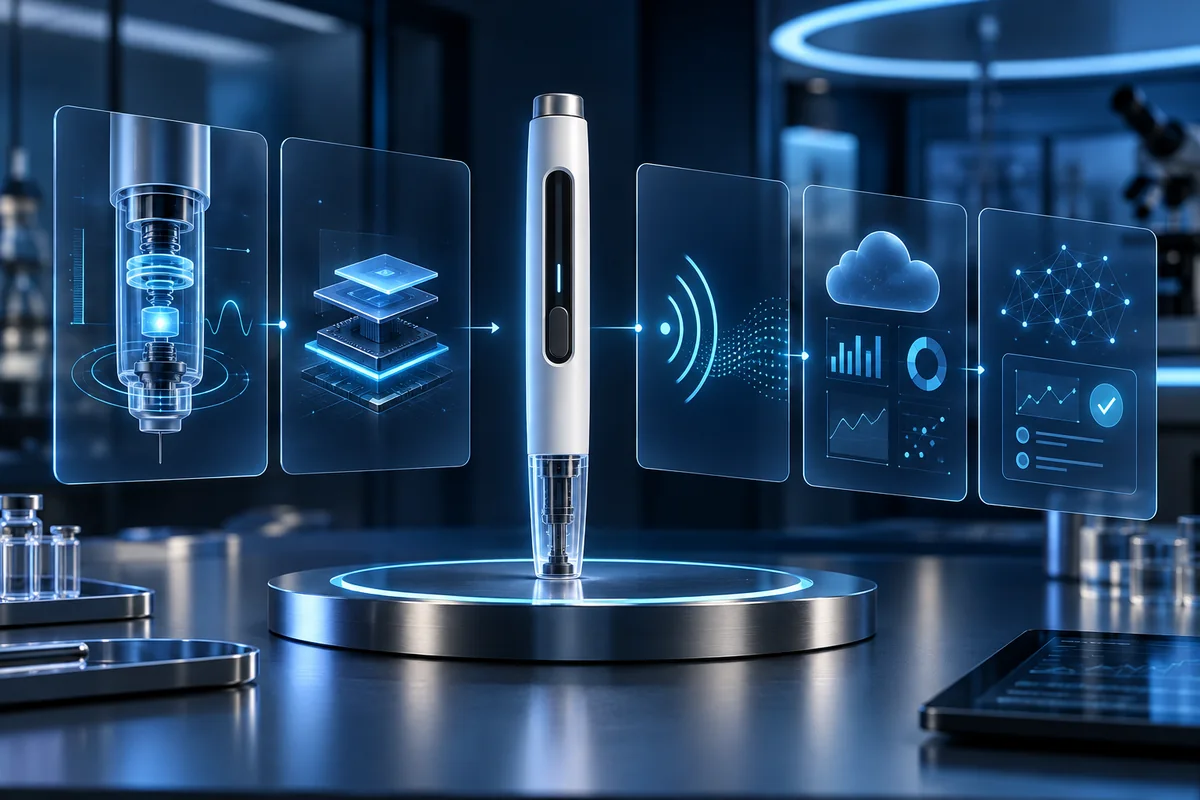
A connected or digital injection pen is not automatically an AI-powered device. The claim depends on the exact function: event capture, reminders, calculation, pattern analysis, prediction or control each requires different inputs, validation and risk controls.
Key parameters to define
- Exact claimed digital or AI function
- Inputs, sensors and data provenance
- Processing location and algorithm version
- User decision versus autonomous control
- Failure, delay and offline behavior
- Software, cloud and update ownership
- Validation and market pathway
Use a capability ladder, not an AI label
Start by identifying the lowest accurate functional level. A mechanical pen may have no digital function. An electronic pen may display or store dose-related information locally. A connected pen may transfer events by NFC or Bluetooth. Software may organize records, issue reminders or calculate information from user-entered settings. More advanced software may detect patterns, generate predictions or recommend an action. Only a defined model or algorithm performing an AI-enabled function should be described as AI, and the description should state what it predicts or classifies, which data it uses and whether a human remains responsible for the decision. Broad wording such as “AI-powered dosing” without a defined function, intended user and evidence can mislead buyers and create an uncontrolled regulatory claim.
Separate sensing, inference and actuation
A smart pen may know that a dial moved, a button was pressed or a mechanism reached a position; that does not necessarily prove that the intended dose entered tissue. Likewise, an app may display CGM data without the pen measuring glucose, and it may calculate a dose without autonomously actuating the device. These boundaries should be represented in the system architecture and user-facing text. For every output, identify the sensor or input, processing location, algorithm version, decision owner, communication path, delay, failure behavior and confirmation method. If machine learning is proposed, the development plan should also address representative data, performance metrics, subgroup analysis, change management and monitoring. Connected-device claims become credible when the complete chain from physical event to displayed conclusion is explicit.
Scope the OEM program around the system
A digital pen project is rarely only a housing customization. The brief should define the pen mechanism, sensors, electronics, power source, firmware, mobile operating systems, app ownership, cloud services, accounts, data model, interfaces, security controls, update route and support responsibilities. It should state whether the product is a logging aid, decision-support function, regulated device software or part of a drug-device combination in the target market. The quotation must separate industrial design, electronics, firmware, software, integration, cybersecurity, verification and ongoing maintenance. HYTANBIO can review platform and engineering fit, but a market-ready AI claim requires a named intended use and an evidence plan owned by the responsible legal and regulatory parties. Record the output, approval owner and change triggers in the project file so procurement, engineering, quality and regulatory teams use the same baseline.
Related technical paths
Smart and Connected Injection Pens · OEM/ODM Services · Connected Pen Cybersecurity Guide
Sources and verification
Use the primary sources below to verify the current requirement and its scope. Requirements can change by device, role, market and version; this guide was reviewed on September 21, 2026.
- FDA — Digital Health guidance collection
- Novo Nordisk — NovoPen 6 and NovoPen Echo Plus
- Medtronic — InPen smart insulin pen system
Questions buyers also ask
No. Bluetooth is a communication method and does not establish an AI-enabled function.
Not necessarily. Many systems receive glucose data from a separate meter or CGM.
No. Calculation, recommendation and physical actuation are different functions with different controls.
Not credibly without a defined function, system architecture, evidence and responsible market pathway.
Describe the measurable function precisely, such as dose-event logging, NFC transfer or reminder support.