
Reviewed November 6, 2026 · For B2B procurement and development teams
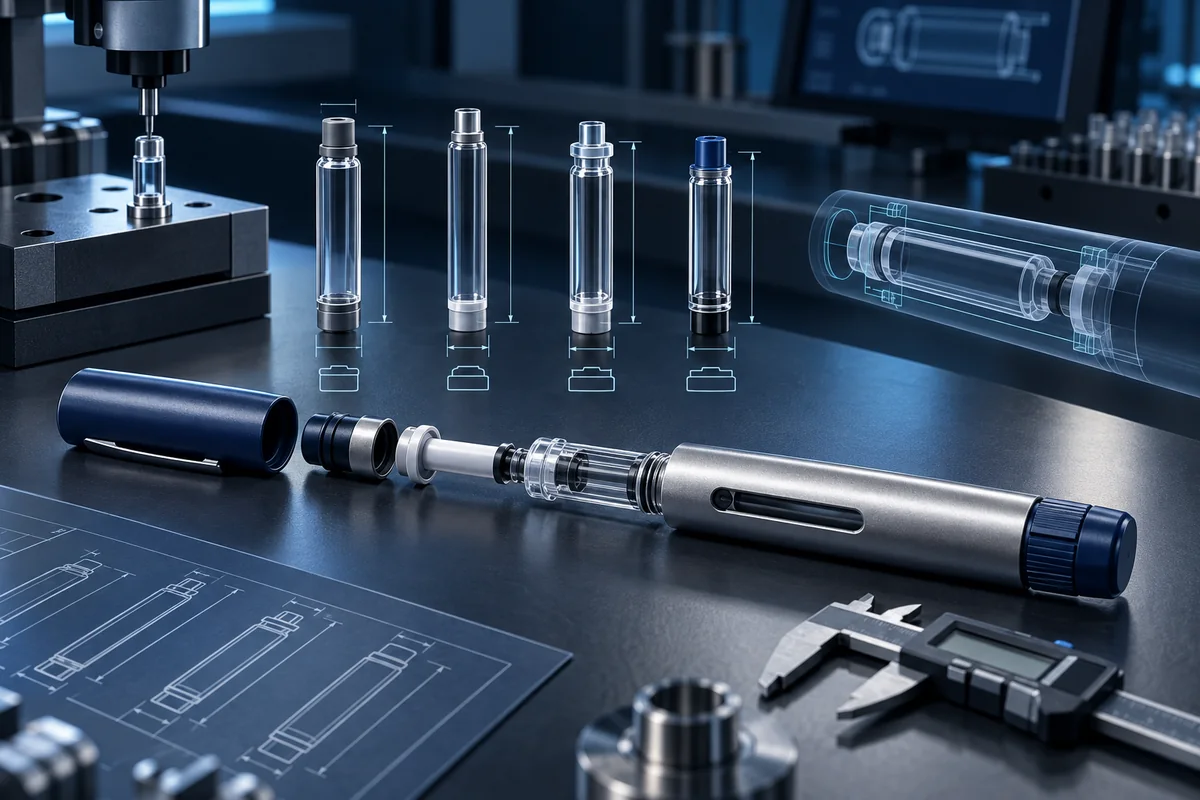
A nominal 3 mL label does not prove that a cartridge fits or performs correctly in an injection pen. Compatibility must be established for the exact container, closure, dimensions, tolerances, force profile, dose mechanism and intended use.
Key parameters to define
- Exact container supplier and drawing
- Nominal and usable volume
- Barrel, neck, flange and stopper dimensions
- Tolerance stack and axial location
- Drive-force range and dose increment
- Storage, temperature and lifecycle assumptions
- Change-control owner and verification scope
Why nominal volume is not enough
Cartridges described with the same nominal volume can still differ in barrel geometry, flange or neck details, stopper design, plunger position, dimensional tolerances, material system and supplier specification. The pen mechanism must locate the container consistently, transmit force without damage and preserve the intended dose-setting and delivery behavior across the permitted operating range. Compatibility therefore cannot be inferred from a catalog photograph, a “standard cartridge” statement or the fact that two devices both mention 3 mL. A defensible assessment identifies the exact container drawing and supplier, examines the pen interface and tolerance stack, and defines the conditions under which the system will be evaluated. ISO 11608-1 provides a framework for needle-based injection-system requirements and testing, but use of an ISO reference does not make all components universally interchangeable.
What a compatibility study should cover
The study should begin with controlled drawings and representative samples of the proposed container and pen. Engineering review normally considers axial and radial location, piston or stopper engagement, available travel, contact stresses, drive force, dose increment, end-of-content behavior, container retention, visual inspection and misuse conditions. Environmental and lifecycle assumptions matter because temperature, storage, repeated handling and material variation can change friction or dimensional response. The plan should state whether the evidence applies to one named cartridge, a defined family or only an early feasibility build. If a medicinal product is involved, the drug or biologic sponsor must also address formulation, container-closure and combination-product responsibilities. A supplier can support mechanical screening, but it cannot declare compatibility with an unspecified drug or every cartridge sold in the market.
Information to include in an RFQ
Send the exact cartridge drawing or controlled specification, supplier and part number where available, nominal fill volume, stopper and closure details, intended dose range and increment, expected maximum and minimum delivered doses, reuse model, target markets and anticipated storage conditions. State whether the device must accept only one cartridge or prevent insertion of alternatives. Identify who owns container procurement and who will approve changes. Ask the pen supplier to list every compatibility assumption, proposed test article, test method, acceptance criterion and unresolved interface risk. The resulting quotation should separate feasibility samples, fixture or tooling changes, verification work and recurring device cost. This prevents an early “3 mL compatible” response from becoming an unsupported production claim and creates a traceable path from container inputs to an approved system configuration.
Related technical paths
Reusable Injection Pens · OEM/ODM Services · Request an Engineering Review
Sources and verification
Use the primary sources below to verify the current requirement and its scope. Requirements can change by device, role, market and version; this guide was reviewed on September 21, 2026.
- ISO 11608-1:2022 — Needle-based injection systems
- FDA — Technical Considerations for Pen, Jet, and Related Injectors
- FDA 510(k) K253747 — configuration-specific disposable pen example
Named insulin injector pen planning guides
Insulin name alone does not define a pen. Concentration, unit-to-volume relationship, dose increment, maximum setting, container, needle interface and intended user can change the mechanism and labeling. Review the named injector pen guide hub for insulin glargine, degludec, lispro and aspart, then provide the exact presentation and sponsor-controlled inputs for engineering evaluation. The guides separate public reference configurations from HYTANBIO’s device scope and do not claim medicine supply, regulatory interchangeability or generic cartridge compatibility.
Questions buyers also ask
No. Nominal volume alone does not establish dimensional, mechanical or performance compatibility.
No. It provides requirements and test methods; the exact device and component configuration still requires evaluation.
Drawings support screening, but representative parts and configuration-specific testing are normally needed before release.
The party controlling the primary container should provide the current controlled drawing and approved supplier information.
Yes, as a feasibility review, provided the open assumptions and evidence limits are clearly stated.